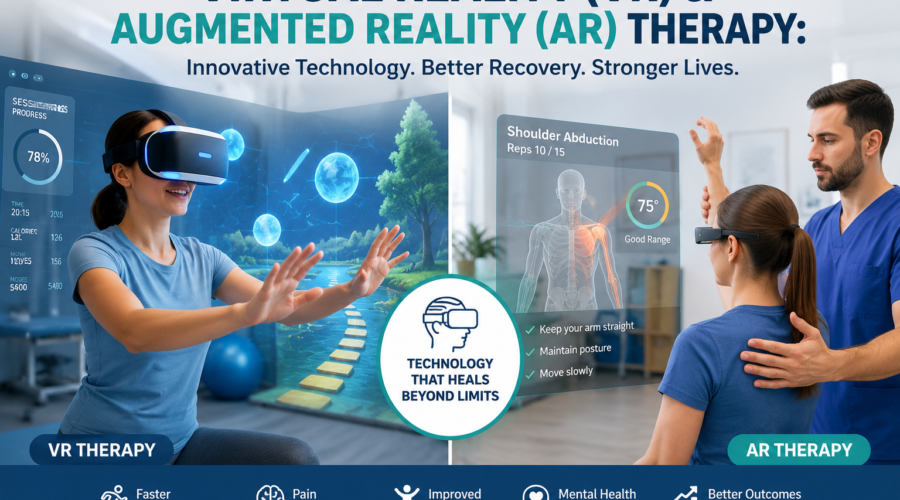
Virtual Reality (VR) & Augmented Reality (AR) Therapy: Transforming Modern Rehabilitation and Patient Care
Technology is changing healthcare faster than ever before. Among the most exciting innovations are Virtual Reality (VR) and Augmented Reality (AR) therapy, which are transforming the way patients receive treatment. From physical rehabilitation and pain management to mental health therapy and medical training, these immersive technologies are making therapy more engaging, effective, and accessible.
Healthcare professionals, physiotherapists, psychologists, and rehabilitation specialists are increasingly adopting Virtual Reality (VR) & Augmented Reality (AR) therapy to improve patient outcomes. These advanced technologies provide interactive environments that motivate patients, reduce anxiety, and accelerate recovery.
In this article, we’ll explore what VR and AR therapy are, their benefits, applications, challenges, and the future of immersive healthcare.
What is Virtual Reality (VR) Therapy?
Virtual Reality (VR) therapy uses computer-generated three-dimensional environments that patients experience through a VR headset. The user is completely immersed in a digital world where they can perform therapeutic exercises, interact with objects, and complete rehabilitation tasks.
VR therapy is commonly used for:
- Physical rehabilitation
- Stroke recovery
- Pain management
- Anxiety treatment
- PTSD therapy
- Phobia treatment
- Cognitive rehabilitation
- Balance training
The immersive nature of VR helps patients focus entirely on therapy while reducing distractions from pain or discomfort.
What is Augmented Reality (AR) Therapy?
Unlike VR, Augmented Reality (AR) therapy overlays digital information onto the real world using smartphones, tablets, or smart glasses.
Instead of replacing reality, AR enhances it by displaying:
- Exercise instructions
- Real-time movement guidance
- Interactive rehabilitation games
- Posture correction
- Muscle activation feedback
AR allows therapists and patients to work together in a real-world environment while receiving digital assistance.
How VR and AR Therapy Work
The therapy process usually follows these steps:
1. Patient Assessment
Healthcare professionals assess the patient’s condition, mobility, pain level, and therapy goals.
2. Personalised Treatment Plan
The therapist selects suitable VR or AR exercises based on the patient’s needs.
3. Interactive Therapy Sessions
Patients complete immersive exercises designed to improve movement, balance, coordination, strength, or mental health.
4. Performance Tracking
The system records:
- Range of motion
- Accuracy
- Completion time
- Balance
- Progress
Therapists use this data to modify treatment plans.
Benefits of Virtual Reality (VR) & Augmented Reality (AR) Therapy
1. Increased Patient Motivation
Traditional therapy can become repetitive and boring. VR and AR convert exercises into interactive games, making rehabilitation enjoyable.
Patients remain engaged for longer periods, improving therapy adherence.
2. Better Pain Management
Research shows that immersive VR experiences distract the brain from pain signals.
VR therapy is widely used for:
- Burn injuries
- Post-surgical recovery
- Chronic pain
- Cancer treatment
- Orthopaedic rehabilitation
Patients often report lower pain levels during VR sessions.
3. Faster Rehabilitation
Interactive environments encourage patients to perform more repetitions without feeling fatigued.
More repetitions often lead to faster recovery in:
- Stroke patients
- Sports injuries
- Neurological rehabilitation
- Joint replacement recovery
4. Improved Balance and Coordination
VR programs simulate walking, climbing stairs, obstacle avoidance, and reaching tasks.
These activities help improve:
- Balance
- Motor control
- Coordination
- Functional mobility
This is especially beneficial for elderly patients and individuals with neurological disorders.
5. Personalised Therapy
Modern VR software adapts to each patient’s performance.
Difficulty levels automatically adjust based on:
- Speed
- Accuracy
- Endurance
- Recovery progress
This creates a customised rehabilitation experience.
Applications of VR & AR Therapy
Physiotherapy
One of the fastest-growing applications is VR in physiotherapy.
Physiotherapists use immersive exercises for:
- Knee replacement recovery
- Shoulder rehabilitation
- Back pain treatment
- Sports injury rehabilitation
- Parkinson’s disease
- Stroke rehabilitation
Patients enjoy therapy while improving mobility.
Mental Health Treatment
VR therapy is revolutionising psychological treatment.
Applications include:
- Anxiety disorders
- Depression
- PTSD
- Social anxiety
- Panic disorder
- Fear of heights
- Fear of flying
Therapists safely expose patients to controlled virtual environments, helping them overcome fears gradually.
Neurological Rehabilitation
Patients with neurological conditions often require repetitive training.
VR provides engaging exercises for:
- Stroke recovery
- Multiple sclerosis
- Cerebral palsy
- Parkinson’s disease
- Brain injury rehabilitation
These exercises stimulate neuroplasticity and improve motor function.
Pain Management
VR distracts the brain from painful stimuli.
It is increasingly used for:
- Burn dressing changes
- Cancer pain
- Labour pain
- Chronic pain
- Phantom limb pain
Many hospitals now include VR therapy in pain management programmes.
Paediatric Therapy
Children respond exceptionally well to game-based rehabilitation.
VR keeps young patients motivated while improving:
- Coordination
- Balance
- Motor skills
- Strength
- Cognitive abilities
Therapy feels more like playing than exercising.
Advantages of Augmented Reality in Rehabilitation
AR offers several unique advantages.
Real-Time Guidance
Patients receive instant feedback on movement quality.
Home-Based Therapy
Patients can perform exercises at home while therapists remotely monitor progress.
Better Posture Correction
AR displays visual cues to correct body alignment.
Reduced Healthcare Costs
Remote rehabilitation reduces unnecessary clinic visits.
Challenges of VR & AR Therapy
Despite its advantages, VR and AR therapy face some challenges.
High Initial Cost
Professional VR systems and software can be expensive for clinics and hospitals.
Motion Sickness
Some users experience:
- Dizziness
- Eye strain
- Nausea
Modern systems are improving to reduce these side effects.
Technology Learning Curve
Both therapists and patients require training before using advanced VR platforms effectively.
Limited Accessibility
Some rural healthcare centres still lack access to VR rehabilitation equipment.
Future of Virtual Reality & Augmented Reality Therapy
The future of Virtual Reality (VR) & Augmented Reality (AR) therapy is incredibly promising.
Emerging technologies such as Artificial Intelligence (AI), wearable sensors, and cloud computing are making rehabilitation smarter and more personalised.
Future developments may include:
- AI-powered therapy recommendations
- Fully remote rehabilitation
- Smart wearable integration
- Haptic feedback systems
- Real-time biometric monitoring
- Virtual physiotherapy clinics
- Multi-user rehabilitation sessions
- Mixed Reality (MR) therapy
As technology becomes more affordable, VR and AR are expected to become standard tools in hospitals, rehabilitation centres, and home healthcare.
Tips for Healthcare Providers Using VR & AR Therapy
To maximise patient outcomes:
- Conduct a thorough patient assessment before starting therapy.
- Choose evidence-based VR and AR rehabilitation programmes.
- Begin with short sessions and gradually increase duration.
- Monitor patient comfort to minimise motion sickness.
- Combine immersive therapy with conventional physiotherapy when appropriate.
- Regularly review performance data and adjust treatment plans.
Conclusion
Virtual Reality (VR) & Augmented Reality (AR) therapy are transforming healthcare by making rehabilitation more interactive, engaging, and effective. Whether helping stroke survivors regain mobility, assisting patients in managing chronic pain, or treating anxiety disorders through immersive experiences, these technologies are reshaping modern medicine.
As innovation continues to advance, VR and AR will become increasingly important in physiotherapy, rehabilitation, mental health, and patient education. Healthcare professionals who embrace these technologies will be better equipped to deliver personalised care and improve patient outcomes in the years ahead.
Frequently Asked Questions (FAQs)
1. What is Virtual Reality (VR) therapy?
Virtual Reality therapy uses immersive digital environments to support rehabilitation, pain management, mental health treatment, and physical therapy.
2. How is Augmented Reality (AR) therapy different from VR therapy?
VR creates a fully virtual environment, while AR overlays digital information onto the real world to guide and enhance therapeutic activities.
3. Is VR therapy effective for physiotherapy?
Yes. VR therapy can improve motivation, balance, coordination, strength, and functional recovery, making it an effective complement to traditional physiotherapy.
4. Can VR therapy help with mental health?
Yes. VR is widely used to treat anxiety, PTSD, phobias, and stress by providing safe, controlled environments for therapeutic exposure.
5. What is the future of VR and AR in healthcare?
The future includes AI-driven rehabilitation, remote therapy, wearable sensor integration, mixed reality applications, and personalised treatment programmes that improve patient outcomes.