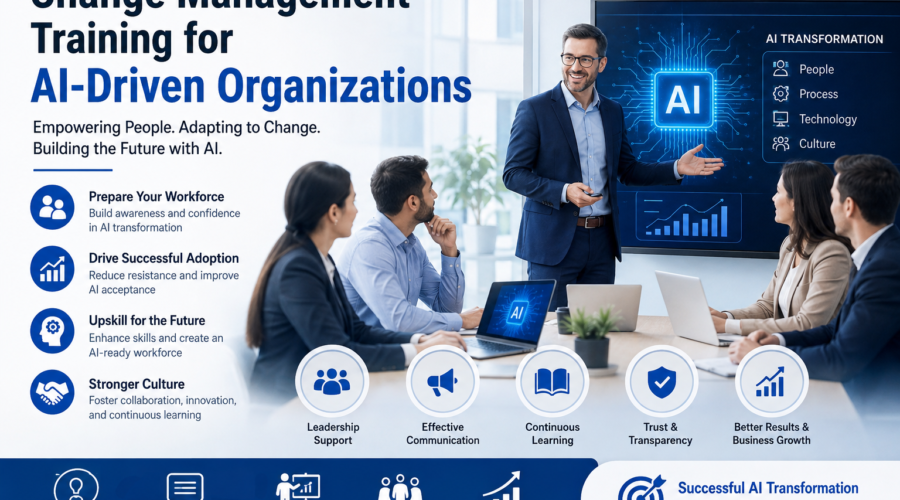
Change Management Training for AI-Driven Organizations: A Complete Guide to Successful AI Transformation
Artificial Intelligence (AI) is changing the way businesses operate. From customer service chatbots to predictive analytics and automation, AI is becoming a key part of modern organizations. However, implementing AI is not only about adopting new technology. It also requires employees and leaders to adapt to new ways of working.
This is where Change Management Training for AI-Driven Organizations becomes essential. It helps organizations prepare employees, managers, and leadership teams for AI transformation while reducing resistance and improving adoption.
In this blog, we’ll explore why change management training is important, its benefits, best practices, and how organizations can successfully build an AI-ready workforce.
What is Change Management Training?
Change management training is a structured learning program that helps employees and leaders understand, accept, and successfully adapt to organizational changes.
When AI technologies are introduced, employees often experience concerns such as:
- Fear of job loss
- Lack of AI knowledge
- Resistance to automation
- Uncertainty about new responsibilities
- Low confidence in using AI tools
Proper training helps eliminate these challenges by providing the skills, knowledge, and confidence needed for AI adoption.
Why AI-Driven Organizations Need Change Management Training
Many AI projects fail because organizations focus only on technology while ignoring the people who use it.
Successful AI implementation depends on:
- Employee engagement
- Leadership support
- Clear communication
- Continuous learning
- Cultural transformation
Without effective change management, employees may resist AI adoption, leading to lower productivity and delayed project success.
Benefits of Change Management Training for AI Organizations
1. Improves AI Adoption
Employees understand how AI benefits their daily work and become more willing to use AI-powered tools.
Higher adoption leads to better return on AI investments.
2. Reduces Employee Resistance
Fear is one of the biggest barriers to AI implementation.
Training helps employees understand:
- AI supports people rather than replacing them.
- New opportunities emerge through automation.
- Upskilling creates long-term career growth.
This reduces anxiety and increases trust.
3. Enhances Employee Skills
Modern organizations require employees to learn:
- AI fundamentals
- Data literacy
- Digital collaboration
- Automation tools
- AI ethics
Change management training prepares employees for these future-ready skills.
4. Builds an AI-Ready Culture
Organizations that embrace continuous learning adapt more quickly to technological changes.
Training encourages:
- Innovation
- Collaboration
- Learning mindset
- Problem-solving
- Digital confidence
5. Increases Productivity
Employees who understand AI workflows can:
- Complete tasks faster
- Make better decisions
- Reduce repetitive work
- Improve customer experiences
This boosts organizational productivity.
Key Components of AI Change Management Training
Successful training programs include several important elements.
AI Awareness
Employees should understand:
- What AI is
- How AI works
- Common AI applications
- Industry use cases
- Business benefits
Knowledge reduces fear and builds confidence.
Leadership Development
Managers play a critical role during AI transformation.
Leadership training focuses on:
- Managing organizational change
- Coaching employees
- Building trust
- Communicating AI strategies
- Handling employee concerns
Strong leadership accelerates AI adoption.
Communication Skills
Clear communication prevents misunderstandings.
Organizations should explain:
- Why AI is being introduced
- Expected business outcomes
- Employee benefits
- Available support
- Learning opportunities
Transparent communication increases employee engagement.
Digital Skills Training
Employees should receive hands-on training in:
- AI software
- Automation platforms
- Data analytics
- Machine learning basics
- Generative AI tools
- AI-powered productivity software
Practical learning builds confidence.
Continuous Learning
AI technology evolves rapidly.
Organizations should create ongoing learning opportunities through:
- Online courses
- Workshops
- Certifications
- AI boot camps
- Webinars
- Internal knowledge sharing
Continuous improvement ensures long-term success.
Common Challenges During AI Transformation
Organizations often encounter several obstacles.
Employee Resistance
Some employees worry AI will replace their jobs.
Solution:
- Communicate openly.
- Focus on reskilling.
- Share success stories.
Lack of Digital Skills
Many employees have limited AI experience.
Solution:
- Offer beginner-friendly training.
- Provide practical exercises.
- Encourage peer learning.
Poor Leadership Support
Without management involvement, employees lose confidence.
Solution:
Train leaders before rolling out AI initiatives.
Communication Gaps
Unclear goals create confusion.
Solution:
Maintain regular communication throughout the AI transformation journey.
Best Practices for Change Management Training
Assess Organizational Readiness
Before implementing AI:
- Evaluate employee skills.
- Identify knowledge gaps.
- Measure digital maturity.
- Define training objectives.
Create a Clear AI Vision
Employees should understand:
- Business goals
- AI roadmap
- Expected outcomes
- Individual roles
A clear vision reduces uncertainty.
Involve Employees Early
Invite employees to:
- Share feedback
- Participate in pilot projects
- Test AI tools
- Suggest improvements
Participation increases ownership.
Personalize Training
Different departments require different AI skills.
For example:
- HR teams use AI for recruitment.
- Marketing teams use AI for content creation.
- Finance teams use AI for forecasting.
- Customer support teams use AI chatbots.
Customized training delivers better results.
Measure Training Success
Track important metrics such as:
- AI adoption rate
- Employee engagement
- Productivity improvements
- Course completion
- User satisfaction
- Business performance
Regular evaluation helps improve future training.
Industries Benefiting from AI Change Management Training
Many industries are investing in AI workforce transformation.
Healthcare
AI supports:
- Diagnostics
- Medical imaging
- Patient management
- Clinical decision-making
Healthcare workers require specialized AI training.
Banking
Financial institutions use AI for:
- Fraud detection
- Customer service
- Risk management
- Personalized banking
Employees must understand AI-powered financial systems.
Manufacturing
Manufacturers use AI for:
- Predictive maintenance
- Robotics
- Supply chain optimization
- Quality control
Training ensures smooth adoption.
Retail
Retail companies leverage AI for:
- Personalized shopping
- Inventory management
- Demand forecasting
- Customer support
Employees learn to work alongside AI tools.
Education
Educational institutions increasingly adopt AI for:
- Personalized learning
- Student performance analysis
- Administrative automation
- Virtual tutoring
Teachers and administrators benefit from AI-focused professional development.
Future Trends in AI Change Management
The future of organizational transformation includes:
- AI-powered learning platforms
- Personalized employee training
- Virtual Reality (VR) learning
- AI coaching assistants
- Predictive workforce analytics
- Microlearning modules
- Human-AI collaboration programs
- Responsible AI and ethical governance training
Organizations that embrace these trends will be better prepared for ongoing digital transformation.
Tips for Building an AI-Ready Workforce
To ensure successful AI adoption:
- Invest in continuous employee learning.
- Encourage experimentation with AI tools.
- Build a culture of innovation and collaboration.
- Prioritize ethical AI practices.
- Develop strong leadership capabilities.
- Celebrate AI success stories to motivate employees.
- Monitor progress and refine training programs regularly.
These practices help employees feel empowered rather than threatened by AI.
Conclusion
Change Management Training for AI-Driven Organizations is a critical factor in achieving successful digital transformation. While AI technology can automate tasks and improve efficiency, its true value is realized only when employees understand, trust, and effectively use it.
By investing in structured AI change management training, organizations can reduce resistance, improve workforce confidence, enhance productivity, and create a culture that embraces innovation. Companies that combine advanced technology with continuous learning and effective leadership will be well-positioned to thrive in an AI-powered future.
FAQs
1. What is change management training for AI-driven organizations?
It is a structured training program that helps employees and leaders adapt to AI technologies, minimize resistance, and support successful organizational transformation.
2. Why is change management important during AI implementation?
It ensures employees understand the purpose of AI, develop the necessary skills, and embrace new workflows, increasing the likelihood of a successful AI rollout.
3. Who should participate in AI change management training?
Executives, managers, team leaders, HR professionals, and employees across all departments should participate to ensure organization-wide AI adoption.
4. What skills are taught in AI change management programs?
Typical topics include AI fundamentals, digital literacy, leadership, communication, data awareness, ethical AI, collaboration, and change adaptation.
5. How does change management training improve AI adoption?
By reducing fear, improving understanding, building confidence, and equipping employees with practical AI skills, organizations can accelerate adoption and maximize the return on their AI investments.